
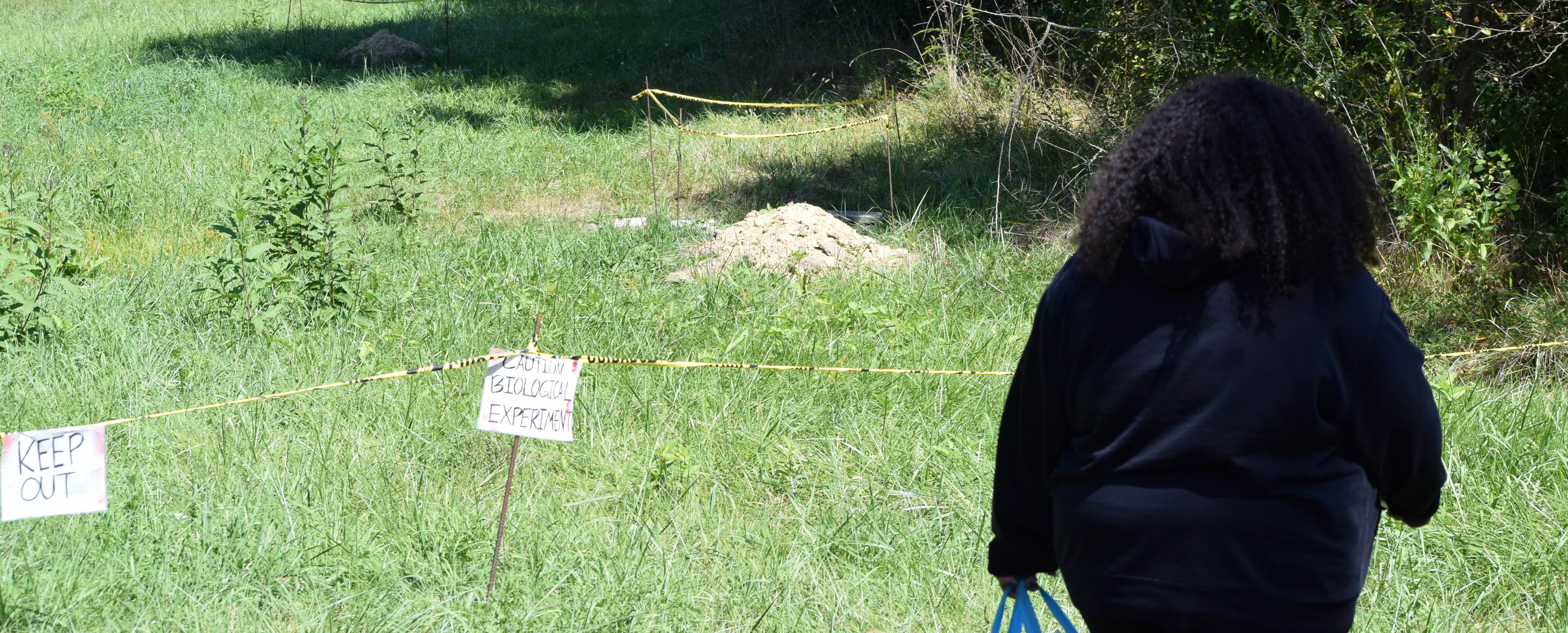
黑料社 students and faculty from several disciplines came together for a research project that blends anthropology, microbiology, zoology, biochemistry and technical writing.
The project is part of 黑料社鈥檚 Summer Undergraduate Research Experience (SURE) program and is connected to, but distinct from, anthropology professor Linda Spurlock, Ph.D.鈥檚 long-running 鈥減ig dig鈥� course.
As part of the SURE research, two pig carcasses were placed under controlled conditions to examine how microbial communities change over time and how those changes relate to odor and insect activity. One carcass was treated with lime, while the other was not.
For undergraduate researchers, the site became a place to connect classroom learning with real data collection, analysis and documentation.

Following microbes through decomposition
Zaniya Houston, a biochemistry sophomore on the pre-med track, and Grace Calvin, a senior zoology major on the pre-veterinary track, collected soil and decomposition samples from the site over an extended period.
According to Spurlock, the students returned to the site regularly to document how decomposition progressed.
鈥淭hey are conducting a study of how the decomposition microbes change over time and how this correlates with smell and insect activity,鈥� Spurlock said.

Sanhita Gupta, Ph.D., a biology professor who works with students at 黑料社鈥檚 Geauga and Twinsburg campuses, supervised the laboratory analysis of the samples. In the lab, students examined bacterial growth patterns and compared results between the lime-treated and untreated sites.
For Houston, the project broadened her view of science and expanded her perspective on future career possibilities.
鈥淚t's a new experience for me and brightens my horizons of all things science,鈥� Houston said. 鈥淚t's opened my eyes to many different things that I can do within the scope of my career and I'm excited for it.鈥�
Calvin said the project also gave her hands-on experience that extended beyond the classroom.

鈥淚 was very excited to go from a classroom setting to an actual hands-on field experience and lab experience,鈥� Calvin said. 鈥淚t鈥檚 really an amazing opportunity just to work with people who are very invested in their field. Having them mentor me is very rewarding.鈥�
Gupta said the project provided students with practical exposure to laboratory work and a clear sense of how research unfolds.
鈥淭his gives them an idea of what research really is in a lab,鈥� Gupta said. 鈥淚t gives them hands-on experience which will help them in their career, whichever path they take.鈥�
From fieldwork to publication
While the research itself was grounded in biological and physical sciences, another component of the project involved translating the students鈥� findings into writing.
Mahli Mechenbier, J.D., an English professor who teaches technical writing at the Twinsburg Academic Center, supported the students as they documented their work and prepared it for potential publication.
鈥淓very scientific project, in a perfect world, has a component of scientific technical writing,鈥� Mechenbier said. 鈥淭hat鈥檚 how you publish your findings in a clear, interesting and ethical way.鈥�
Learning through collaboration
For the students, collaboration meant learning to communicate clearly with people outside their own disciplines.
鈥淵ou have to explain what you鈥檙e doing and why it matters,鈥� Houston said, describing the experience of working across disciplines.

Preparing students for what comes next
Faculty involved in the project say experiences like this help prepare students for future academic and professional work.
Gupta said long-term involvement in research helps students gain independence and confidence.
鈥淲hen they started, they didn鈥檛 know how to proceed with this,鈥� Gupta said. 鈥淣ow they are experts. I don鈥檛 even have to be here鈥擨 lead them and they do the rest of the work.鈥�
Mechenbier pointed to students鈥� participation in research presentations, including short-format research pitches, as particularly valuable.
鈥淭hat kind of practice is important for graduate school, medical school interviews and job interviews,鈥� she said. 鈥淚t forces students to think about what matters most in their work and how to explain it clearly.鈥�
The research is ongoing, with extensive laboratory analysis still ahead. Houston and Calvin collected a large number of samples and additional data, including temperature readings, odor intensity observations and insect activity, meaning analysis will continue for many months.
This summer, two additional SURE students will continue the project鈥檚 laboratory phase: Zaniya Houston (Biology, pre-med) and Joey Colbetzor (Anthropology). Their primary role will be to identify and quantify microbial changes documented in the many samples Houston and Grace Calvin collected during the summer and fall as the pigs decomposed. Their findings will be correlated with other data gathered during the decomposition process, including insect activity, ambient temperature and odor observations. Soil samples collected at different stages of decomposition, along with control samples, will also be used to grow plants in a laboratory setting to further examine environmental effects.
The questions guiding the work remain open: Does treating remains with lime delay decomposition? Accelerate it? Reduce foul odors? These answers are not yet known.
According to Spurlock, these questions are especially important because lime is sometimes used in clandestine burials, making the findings relevant to the field of forensic science.
For students, the project offered a realistic look at both the demands and rewards of scientific research.
鈥淛ust being out in the field and fully involved in the research has been my favorite part,鈥� Calvin said. 鈥淓ven if you鈥檙e anxious or think you鈥檙e not qualified, anyone can learn and contribute over time to an amazing study like this.鈥�
###