
To the untrained eye, a map is simply a lattice of lines and labels, a static snapshot of where things sit. But for those who understand the 鈥渓ay of the land,鈥� geography is less about coordinates and more about the heartbeat of a community. It is the art of documenting where we belong, and recently, a group of aspiring educators in the Early Childhood Education program set out to prove that if you want to change the world, you must first learn how to chart it.
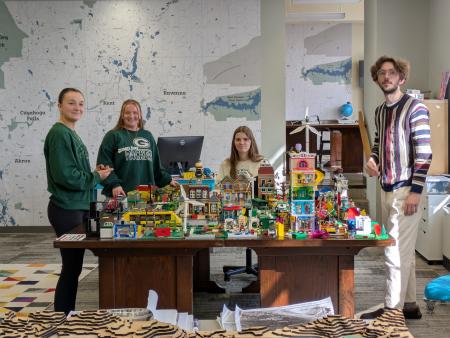
Stepping into 黑料社鈥檚 in McGilvery Hall on the Kent Campus, two classes of ECED students found themselves in a space where boundaries are meant to be pushed. Created by Assistant Professor of Geography Jennifer Mapes, the lab serves as a vibrant hub where geography meets social action. For these pre-service teachers, the visit wasn't just a field trip; it was a masterclass in how spatial thinking can foster better citizens.
鈥淕eography is more than just locations, it鈥檚 about the relationships between people, places, things, environments, other species, and relationships of value,鈥� said Professor Janice Kroeger, Ph.D. 鈥淏y teaching children to map their worlds, we are giving them the tools to see themselves as active participants in their own communities.鈥�
Under the inspired guidance of Professor Mapes, the students grappled with the "why" behind the "where." They explored how maps help communities decide how to use their space and why certain neighborhoods change over time. It became clear that when communities are mapped, it鈥檚 not just a diagram of roads, it鈥檚 a documentation of history, resources, and a shared identity.
Associate Professor of Social Studies Education Elizabeth Kenyon, Ph.D., notes the vital role the subject plays in the classroom: 鈥淲hen young learners engage with geography, they start to ask critical questions about fairness, access, and the way their world is structured. It鈥檚 the foundation of civic engagement.鈥�
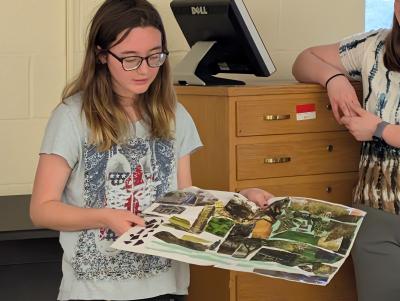
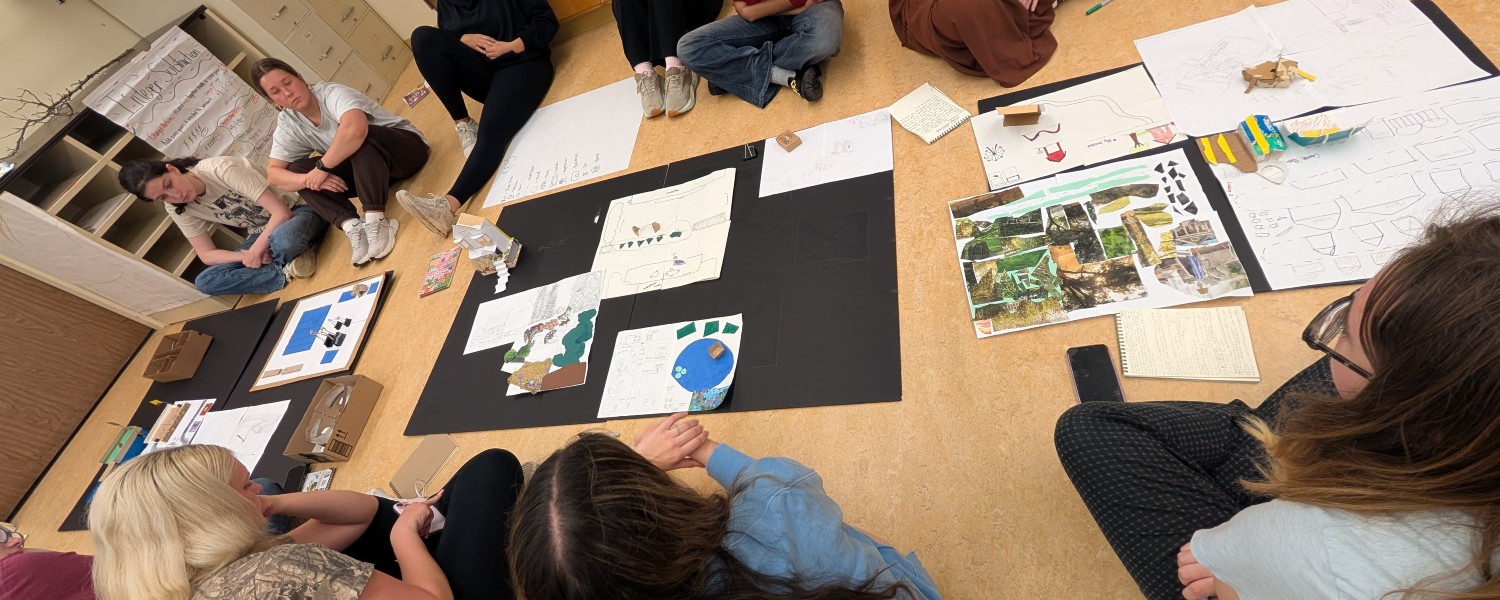
The inspiration was extended in Professor Kroeger鈥檚 section, where students transitioned from observers to cartographers, reaching back into their own histories, drawing maps of favorite childhood places鈥攕chool playgrounds and neighborhood parks, as well as longstanding family traditions like multi-state travel, fishing trips and meals at Golden Corral 鈥攔eminiscing through spatial reasoning. Still, others wrote about the rigors of mapping dance studios, gymnastics competitions and hockey games.
Following Ohio鈥檚 geography and social studies standards, they developed map keys, a sense of place, practiced cardinal directions while transforming abstract concepts into tangible mapping skills.
As these ECED students work toward creating their own, future classrooms, they will carry more than just lesson plans, they will carry a new perspective on community. They鈥檝e learned that while a compass can point you in any direction, geography and community evolution, coupled with strong relationships and positive routines, is what helps a child find their place in the world.