
ºÚÁÏÉç

Image
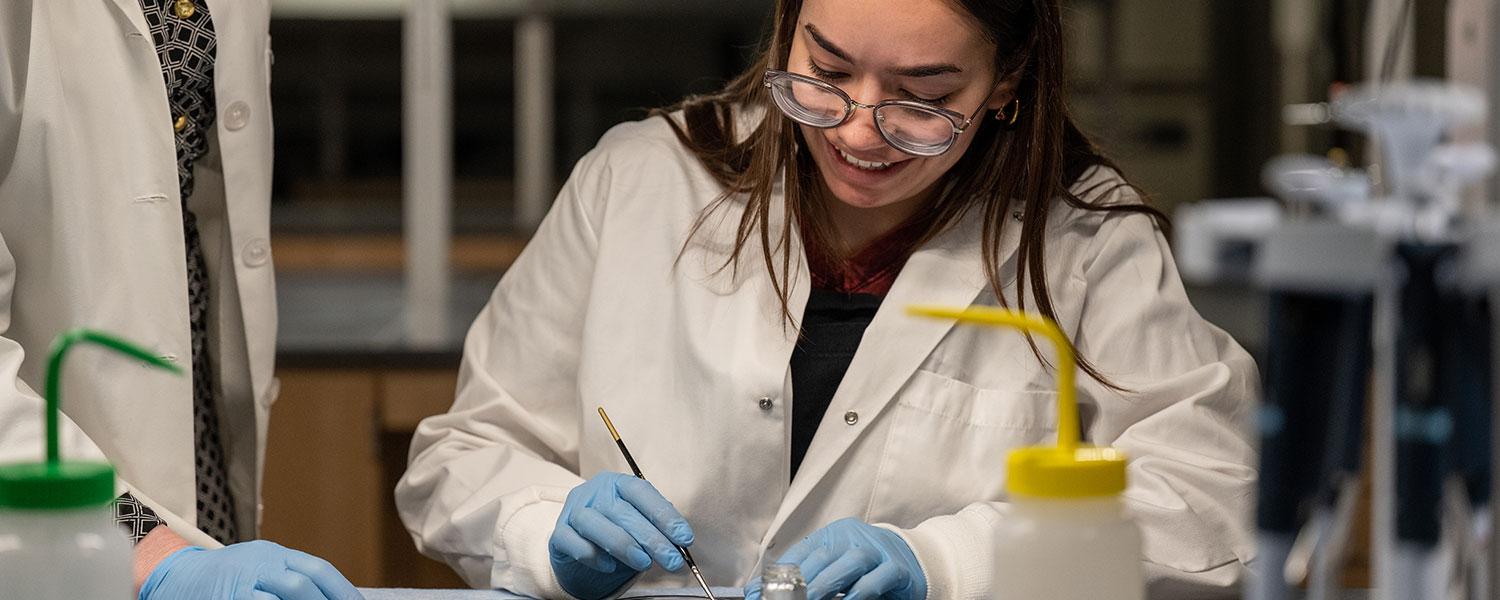
Student performs experiment in lab

Biological Sciences - Ecology and Evolutionary Biology - M.S.

The Master of Science degree in Biological Sciences - Ecology and Evolutionary Biology provides opportunities to study in areas such as animal behavior, entomology, limnology, microbial ecology, ornithology, systems ecology, systematic and evolutionary biology, environmental physiology, vertebrate ecology and population and community ecology. Although courses of study are tailored to students’ interests and needs, the program for all students normally includes training in population, community, ecosystems and evolutionary ecology and statistical theory. Because of the interdisciplinary nature of ecology, students are encouraged to take courses in geology, mathematics, chemistry and other disciplines.

Contact Us

Apply Now
Request Information
Schedule a Visit

Access English Proficiency WaiversSee if you are eligible for an English Proficiency Waiver.   


Master's Degree in Ecology and Evolutionary Biology 

Uncover the dynamics of ecosystems and evolutionary processes with ºÚÁÏÉç’s Master of Science degree in Ecology and Evolutionary Biology. Through advanced coursework and field research, gain deep insights into ecological systems and evolutionary patterns. Our program prepares you for careers in environmental consulting, research, and conservation.

There are NO Application Fee Waivers being offered for Fall 2026 Admission.

Program Information for Biological Sciences - Ecology and Evolutionary Biology - M.S.

Program Description

Full Description

The Master of Science degree in Biological Sciences - Ecology and Evolutionary Biology provides opportunities to study in areas such as animal behavior, entomology, limnology, microbial ecology, ornithology, systems ecology, systematic and evolutionary biology, environmental physiology, vertebrate ecology and population and community ecology. Although courses of study are tailored to students’ interests and needs, the program for all students normally includes training in population, community, ecosystems and evolutionary ecology and statistical theory.

Because of the interdisciplinary nature of ecology, students are encouraged to take courses in geology, mathematics, chemistry and other disciplines.

Admissions for Biological Sciences - Ecology and Evolutionary Biology - M.S.

For more information about graduate admissions, visit the graduate admission website. For more information on international admissions, visit the international admission website.

Admission Requirements

  • Bachelor's degree from an accredited college or university
  • Undergraduate coursework roughly equivalent to the Biology minor
  • Minimum 2.750 undergraduate GPA on a 4.000-point scale
  • Official transcript(s) - copies of official transcripts can be submitted for initial review of application
  • Résumé or curriculum vitae
  • Personal statement that clearly explains why the applicant wishes to pursue an advanced degree and describes research experience and interest; statement must include a list of potential faculty mentors
  • Three letters of recommendation that comment on chance of success in an advanced degree program, with minimum one from someone who can comment on research aptitude
  • English language proficiency - all international students must provide proof of English language proficiency (unless they meet specific exceptions to waive) by earning one of the following:1
    • Minimum 94 TOEFL iBT score
    • Minimum 7.0 IELTS score
    • Minimum 65 PTE score
    • Minimum 120 DET score
1

International applicants who do not meet the above test scores will not be considered for admission.

Application Deadlines

  • Fall Semester
    • Priority deadline: November 15

All application materials (including applicable fee, transcripts, recommendation letters, etc.) submitted by this deadline will receive the strongest consideration for admission.

Learning Outcomes

Program Learning Outcomes

Graduates of this program will be able to:

  1. Explain advanced biological concepts specific to ecology and evolutionary biology beyond the undergraduate level.
  2. Design experiments to test scientific hypotheses using appropriate methods and research techniques.
  3. Conduct original research studies to investigate specific biological questions and present findings.
  4. Communicate scientific findings effectively to disciplinary and interdisciplinary audiences.

Coursework

Program Requirements

Major Requirements

Major Requirements
BSCI 60104BIOLOGICAL STATISTICS 4
BSCI 60184RESPONSIBLE CONDUCT IN RESEARCH AND TEACHING-BIOLOGICAL SCIENCES 12
BSCI 60191SEMINAR IN BIOLOGY (taken 2-4 times)2-4
or BSCI 60391 SEMINAR IN ECOLOGY
BSCI 60370ECOLOGICAL AND EVOLUTIONARY GENETICS 2
or BSCI 60371 EVOLUTIONARY BIOLOGY
BSCI 60372COMMUNITIES AND ECOSYSTEMS 2
or BSCI 60373 POPULATION AND COMMUNITY ECOLOGY
Major Electives, choose from the following:12-14
ESCI 50380
BIOGEOCHEMISTRY
ESCI 52065
WATERSHED HYDROLOGY
ESCI 53500
ENVIRONMENTAL SOIL SCIENCE
GEOG 59070
GEOGRAPHIC INFORMATION SCIENCE
GEOG 59073
ENVIRONMENTAL DATA ANALYSIS IN R
GEOG 59075
GEOGRAPHIC INFORMATION SCIENCE: APPLICATIONS FOR SOCIAL PROBLEMS
Other graduate courses as approved by guidance committee
Culminating Requirement
BSCI 60199THESIS I 26
Minimum Total Credit Hours:32
1

Students are required to enroll in BSCI 60184 their first semester (or the following fall semester for those starting their studies in the spring semester).

2

After completing 6 credit hours of BSCI 60199, students must register continually for BSCI 60299 until the degree is earned. Credit hours for BSCI 60299 do not count toward the degree. Students begin research by successfully preparing, presenting and defending a formal prospectus for their research project to their committee. For the thesis and final defense, it is expected that students will present the results of their study in a defense open to students and faculty. The thesis must be presented and defended before the guidance committee.


Graduation Requirements

Minimum Major GPA Minimum Overall GPA
- 3.000
  • Students are required to present at least one departmental seminar about their work.
  • Students must complete a minimum 14 credit hours of graduate courses beyond BSCI 60198 toward their degree.
  • Students will present the results of their study in a defense open to students and faculty. The thesis must be presented and defended before the Guidance Committee with not more than one negative vote in order to be recommended to the Department of Biological Sciences and the College of Sciences and Humanities for degree conferral.
  • No more than one-half of a graduate student’s coursework may be taken in 50000-level courses.
  • Grades below C are not counted toward completion of requirements for the degree.
Program Delivery

  • Delivery:
    • In person
  • Location:
    • Kent Campus

M.S. Timeline
  • Semester 1: Form faculty guidance committee
  • End of Semester 1: Create a program of study to define required coursework
  • End of Semester 2: Generate a research proposal
  • End of year 2: Complete all required coursework
  • Final Semester (average 2 years):
    • Complete Thesis
    • Give Department seminar (30-minute)
    • Pass final oral defense
Competitive Applications

GPA average for accepted students 3.5

  • Minimum GPA 2.75 required; however, applicants must demonstrate an ability to maintain a 3.0 GPA in graduate coursework.  Applicants can demonstrate this by meeting one or more of the following conditions:
    • Earned an undergraduate degree from an accredited institution with 3.0 GPA.
    • Completed 9 or more graduate hours in graded coursework at an accredited institution and earned a 3.0 cumulative GPA or above.
    • Earned a 3.0 cumulative GPA in undergraduate courses related to the academic program to which the applicant has applied.
    • Earned a 3.0 cumulative GPA in the last 60 credit hours of completed undergraduate courses.
    • Solid science background with a focus in the program  area to which the applicant applied
    • Clearly explain in their personal statement why they wish to pursue a MS or PhD in Biology, a description of their research experience and outline their research interests and long-term goals. Students should identify 3-5 faculty who they are interested in working with based on their and the faculty’s research interests. Faculty research interests can be found on the program webpages. 

Examples of Possible Careers and Salaries for Biological Sciences - Ecology and Evolutionary Biology - M.S.

Graduates of ºÚÁÏÉç's Master of Science degree in Ecology and Evolutionary Biology are prepared for a range of impactful careers. They can work as biological scientists, focusing on research and data analysis in diverse ecosystems. Opportunities also exist for environmental science teachers, where they educate future generations about ecological principles.

Biological science teachers, postsecondary

7.3%

faster than the average

66,000

number of jobs

$83,460

potential earnings

Biological scientists, all other

1.2%

slower than the average

63,700

number of jobs

$93,330

potential earnings

Environmental science teachers, postsecondary

2.9%

slower than the average

9,000

number of jobs

$87,710

potential earnings

Natural sciences managers

3.7%

about as fast as the average

104,300

number of jobs

$161,180

potential earnings

Notice: Career Information Source
* Source of occupation titles and labor data comes from the U.S. Bureau of Labor Statistics' . Data comprises projected percent change in employment over the next 10 years; nation-wide employment numbers; and the yearly median wage at which half of the workers in the occupation earned more than that amount and half earned less.